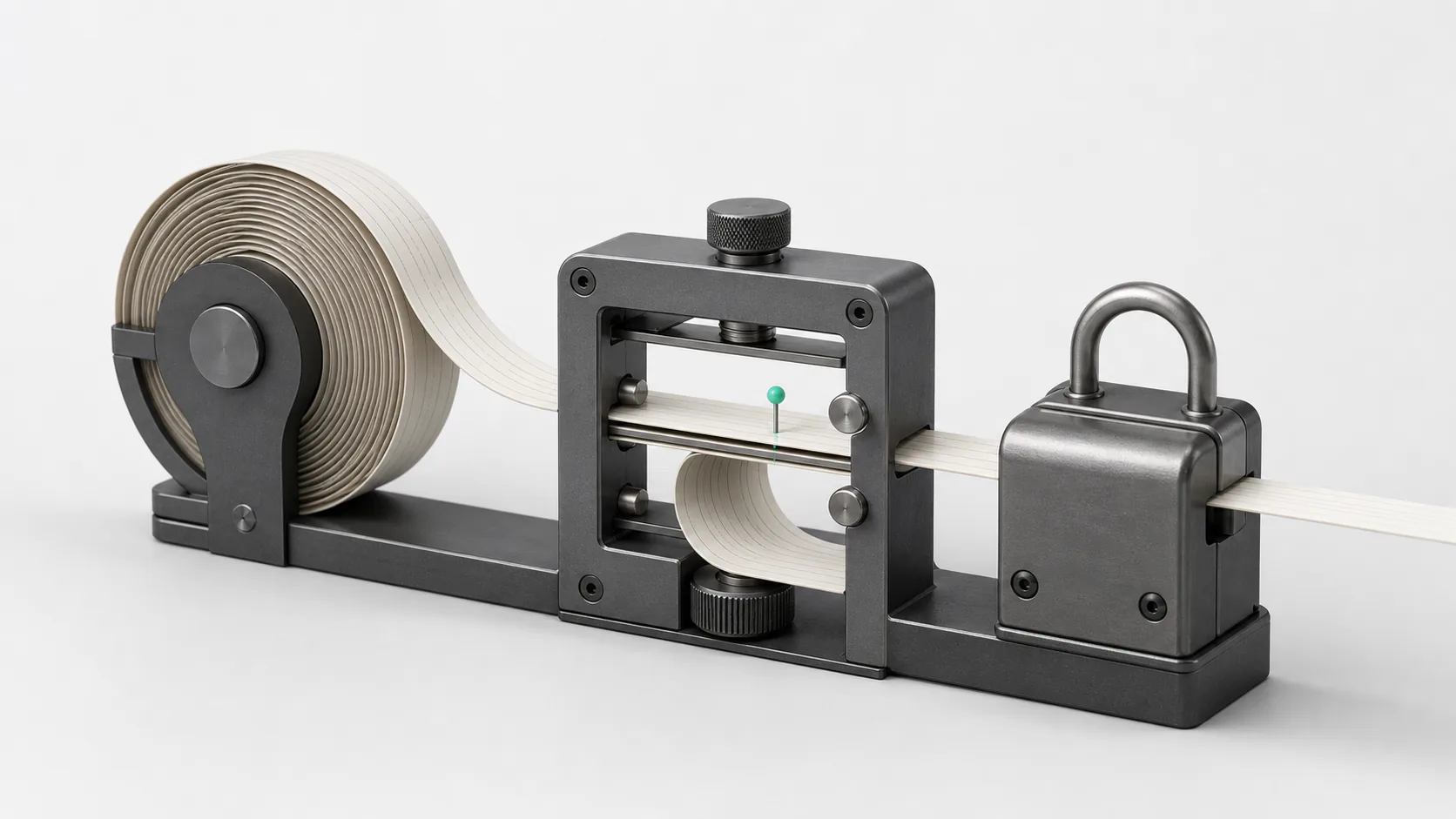
A strategy has to survive recorded market state before it gets near a broker
A finished chart is generous. It shows the whole path at once. The turning point is obvious because the future is already drawn to its right.
Research becomes less comfortable when that future disappears.
We built a real-time and historical model that lets us run through market history as if it were the present. It is custom to the constraints and specifics of our range model. At each step, the system gets the information available at that point and has to carry its own state forward. The rest of the chart has not happened yet.
That is what we mean by replay.
Make the past arrive
The first useful replay is rarely the prettiest. You start the clock, watch a familiar period rebuild, and notice that an idea that looked clear on the completed chart hesitates when it has to live through the sequence.
That hesitation teaches something. Perhaps two parts of the model disagree about when a range has changed. Perhaps a condition remains active longer than the research summary suggests. Perhaps a decision depends on context that the live-shaped model does not actually have. A conventional report can smooth over those edges because it begins with completed data.
Replay keeps the edges.
The historical market passes through the same conceptual objects used by the live product: fixed ranges, related sizes, current conditions, and state that develops over time. The purpose is parity of experience, not a dramatic animation of an old chart. We want to know whether the model remains itself when history has to unfold.
The useful result is often a disagreement
A replay run can disagree with an earlier research result. Our instinct is to stop there, not average the two or select the more flattering number.
The disagreement becomes a question with a location. What did each environment know at that moment? Which assumption existed only because the full history was available? Did the live-shaped run encounter a boundary the research model ignored? The answer can lead to a correction, a narrower claim, or the rejection of an idea.
This is why replay belongs before risk. It turns vague confidence into inspectable behavior.
The visual review matters too. We can pause at the first divergence and ask what the model believed the market looked like at that point. The completed chart stops dominating the conversation. A range that had not closed remains open. A continuing condition is not treated as a fresh one. The state on screen reflects the information that had actually arrived.
That makes replay useful to people who do not need a performance report. It gives research a scene that can be inspected: one historical moment, one available state, and one decision that either follows the stated rules or does not.
It also makes the software easier to reason about outside strategy research. Recovery work can be tested against known sequences. A visual transition can be checked while the underlying state advances. A change to the range model can be compared against prior behavior without pretending every difference is an improvement.
Custom does not mean magical
Generic backtesting tools are useful for many strategies. Our model has its own range definitions, timing, and state relationships, so the historical environment needs to understand those same constraints. Otherwise we would test a convenient approximation and operate a different system.
The custom work lives in that alignment. We do not need a replay engine that imitates every platform. We need one that can reproduce the questions our live product asks, in the order it asks them.
There is no claim of perfect simulation. Historical data has limits. Broker conditions vary. A live environment introduces delays and failures that a recorded sequence cannot fully recreate. We treat those gaps as part of the review, not details to bury beneath a performance curve.
Rejection is progress
Research tools are easy to love when they confirm an idea. A replay system earns trust when it makes rejection cheaper.
If a condition only looks useful with future context, we want to learn that before it reaches a demo terminal. If a model cannot recover its state cleanly, we want the break in a recorded run. If two versions produce different paths, we want to inspect the first divergence rather than compare only the ending.
A successful replay does not make live execution safe. It does not predict the next market event, and it cannot replace active supervision. It gives us a more exact question: when this model meets history one moment at a time, does it follow the rules we said it follows?
That question is harder to answer than “did the line go up?” It is also worth much more.