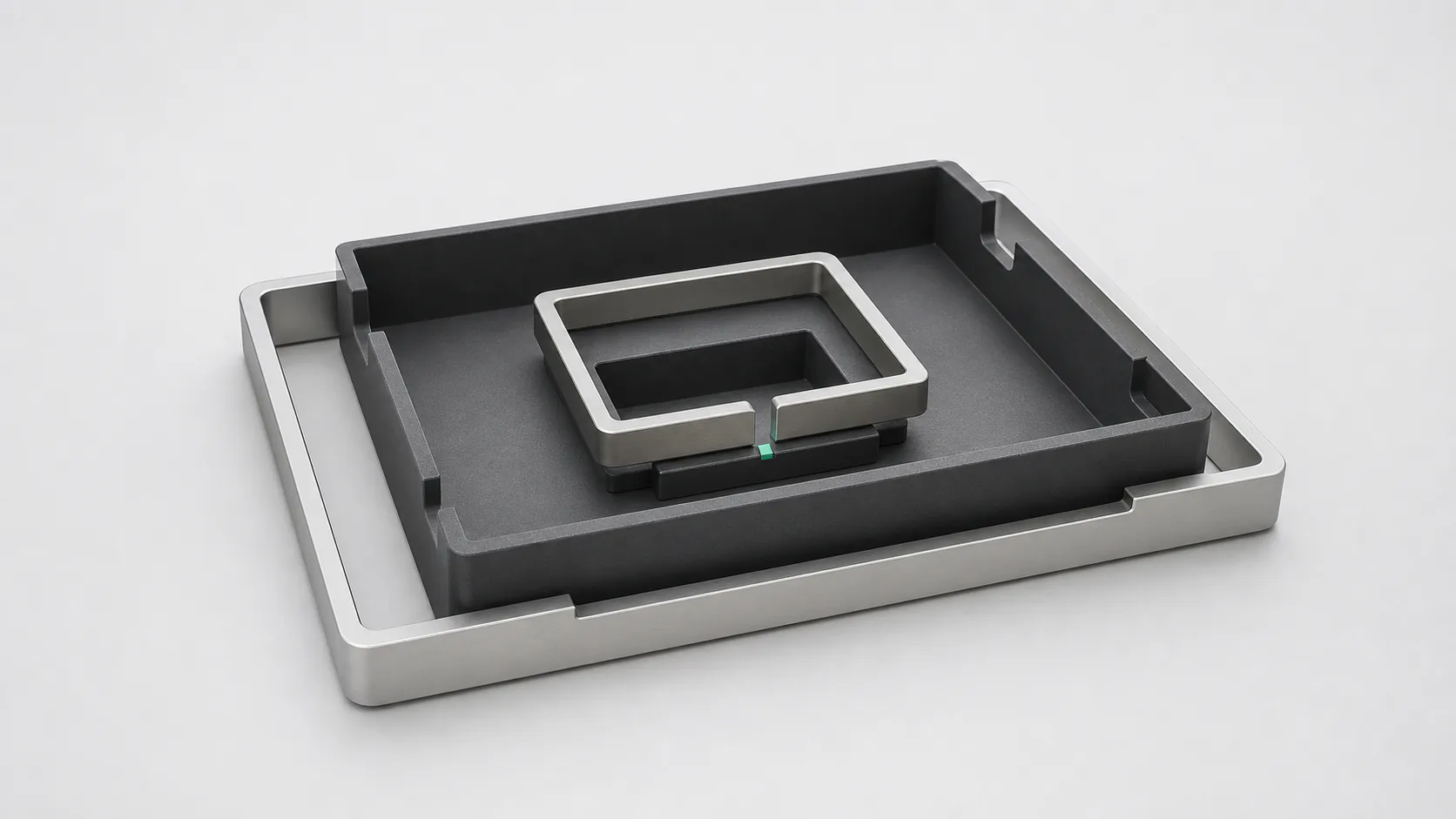
Why fixed price ranges remain the product's basic unit
Our first experiment began with a rectangle and a question that would not leave us alone: what changes when price distance stays fixed and time is allowed to vary?
In the early experiments, the box was almost embarrassingly simple. Give it a range. Let price move inside it. Complete the shape when price crosses the boundary. A busy market could create several boxes quickly; a quiet market could remain inside one for much longer.
By November 2024, that object had a name: ResoBox.
A different container changes the reading
Time-based candles remain useful. They divide a session into regular intervals and summarize what happened inside each one. Change the interval and the same movement is grouped into a different set of containers.
We wanted a stable unit for comparing movement across scales. A fixed price range supplied it. A small box and a large box measure different distances, yet the rule remains the same. Time still passes; it simply stops deciding when every new shape must appear.
The first working box made one relationship especially clear. Activity affected the rhythm of the display. During faster movement, boxes completed closer together. During quiet periods, the current box held. The view expanded where price traveled rather than where the clock allocated space.
That was enough to build on.
One box became a family
A single range shows local movement. Several related sizes show context.
Smaller boxes respond first. Larger boxes require more distance before their state changes. When several sizes point in the same direction, the relationship is visible. When the smallest range turns while the larger ones hold, that disagreement is visible too.
The early work was full of practical mistakes. History could begin at the wrong point. A color change could affect which boxes appeared. The smallest range could draw a following line from the wrong edge. Each bug clarified the object because the expected behavior had to be stated precisely.
By the end of 2024, the box could animate, remember more of its view, and sit inside a grid. The work was moving from a calculation toward an interface.
Motion made the rule easier to test
The first working animation in December did more than make the rectangle feel alive. It exposed the exact moment a box should complete.
A decorative animation can interpolate between two finished states and look convincing. The useful animation had to wait for price to cross a fixed boundary. Only then could the next box occupy its place. Watching that transition made errors in high, low, direction, and history easier to recognize than reading a final array of values.
This remains our standard for product motion. The animation should reveal the rule. If price is still inside the range, the box holds. If a smaller range completes while a larger one remains open, the view should show both truths at once. Motion earns attention by making state change inspectable.
The descendants kept the rule
The Line view connected range state into a simpler trace. The dashboard repeated the object across markets. The 3D view explored depth between related sizes. Ryver arranged completed movements along a continuous path. Trend Hints watched for selected conditions within the same range language.
These views do not need to look alike. Their connection is stronger when each one emphasizes a different relationship while keeping the underlying range recognizable.
This is why the box still appears throughout the visual identity. It is not a logo pasted onto the site. It is our first useful product constraint.
Fixed distance has its own tradeoff
Removing the clock from the shape does not remove time from the market. It changes which variable controls the display.
A fixed range can make active movement easier to compare, but quiet periods may remain visually compressed. The view does not explain how long price stayed inside a boundary unless another part of the interface provides that context. A very small range can react quickly and become noisy. A large range can hold context and respond too slowly for the question a person is asking.
The family of sizes helps because no single box has to serve every reading. The user can move between detail and context while preserving the rule. The choice of size still matters, and the interface should never hide that choice behind a supposedly universal setting.
The box cannot explain the market
Simplicity can create false confidence. A completed range records that price traveled far enough to cross a defined boundary. It does not explain why the movement happened. It does not say whether the direction continues or whether taking risk makes sense.
Related boxes add context, not certainty. A pattern can describe a current relationship, not guarantee the next one. Keeping those limits visible lets the object stay useful without asking it to become a theory of everything.
The first ResoBox gave us a compact way to talk about movement. Two years later, the surrounding product is larger, but it still returns to that first question: how much can a fixed range reveal when the clock gets out of the way?